
Lanturn’s Blog
How to Write Fast

My first blog post took me 5 months to write. The last one took 5 hours.
And it was honestly better.
In the first one, I had so many ideas, so many ways to put them together, so many points I wanted to express. I wrote one good paragraph, and then another. But the two didn’t fit together. So I rewrote them both. Only after a dozen iterations of re-starting the piece, the parts finally started to connect, and a coherent thread with a single point came together.
Over the next two years, that entire process of thinking of the topic, to pressing publish took just a few hours.
But what changed?
First, practice made a huge difference. The more you write, the more you learn how to develop a half-baked idea, express it on the page, and edit until it's ready. I just got better at writing, and more confident at posting without overthinking it.
But there is a deeper mechanism that speeds up writing. And solving for it can help you publish faster.
My first post took so long because my writing process was carrying too many decisions at once.
What is the format of the post? What is the main point? What is my writing style? Do I go heavy on conceptual framework, personal experience, or examples? Every sentence had to revisit all of these decisions because they were still floating around.
It was like trying to plan a trip to Tokyo without knowing my budget, who else is coming, or even what kind of trip I wanted. Was this going to be a cultural exploration? Foodie trip? Attraction hopping? You can't really book a Tuesday dinner without knowing some of these upfront.
So the solution for this kind of slowness isn't just “keep writing” or “overcome your perfectionism.”
It is more so:
Decide the parameters of your writing upfront, so the words flows from a smaller set of possibilities.
With me, as I kept writing, I naturally developed my style and a point of view. Then, every new post inherited the hundreds of decisions I had already made. Just like planning is 100 times easier on your 5th Tokyo trip.
And, once I got intentional about cutting possibilities, I started doing it upfront, before I write any part of my post.
Towards the beginning of writing a piece, I now clarify as much as I can:
1. What is the main point?
The one takeaway that anchors every paragraph.
For this blog post, it is:
Write faster by limiting the number of decisions you need to make while writing.
2. What is the structure?
What are the high-level sections that put the idea together?
For this post:
- Introduce the felt problem.
- Explain the obvious way of looking at it.
- Show a less obvious root cause: the vast number of decisions slows down writing.
- Give the reader a simple way to solve it.
- Land the point.
3. At what quality level will I call it done?
This clarification helps me a lot with avoiding the urge to make every word perfect.
If the main point comes through clearly in the structure I decided on, then let’s just ship it.
Those are the preliminary questions that help me move fast when writing without going back and forth in between points and writing structures.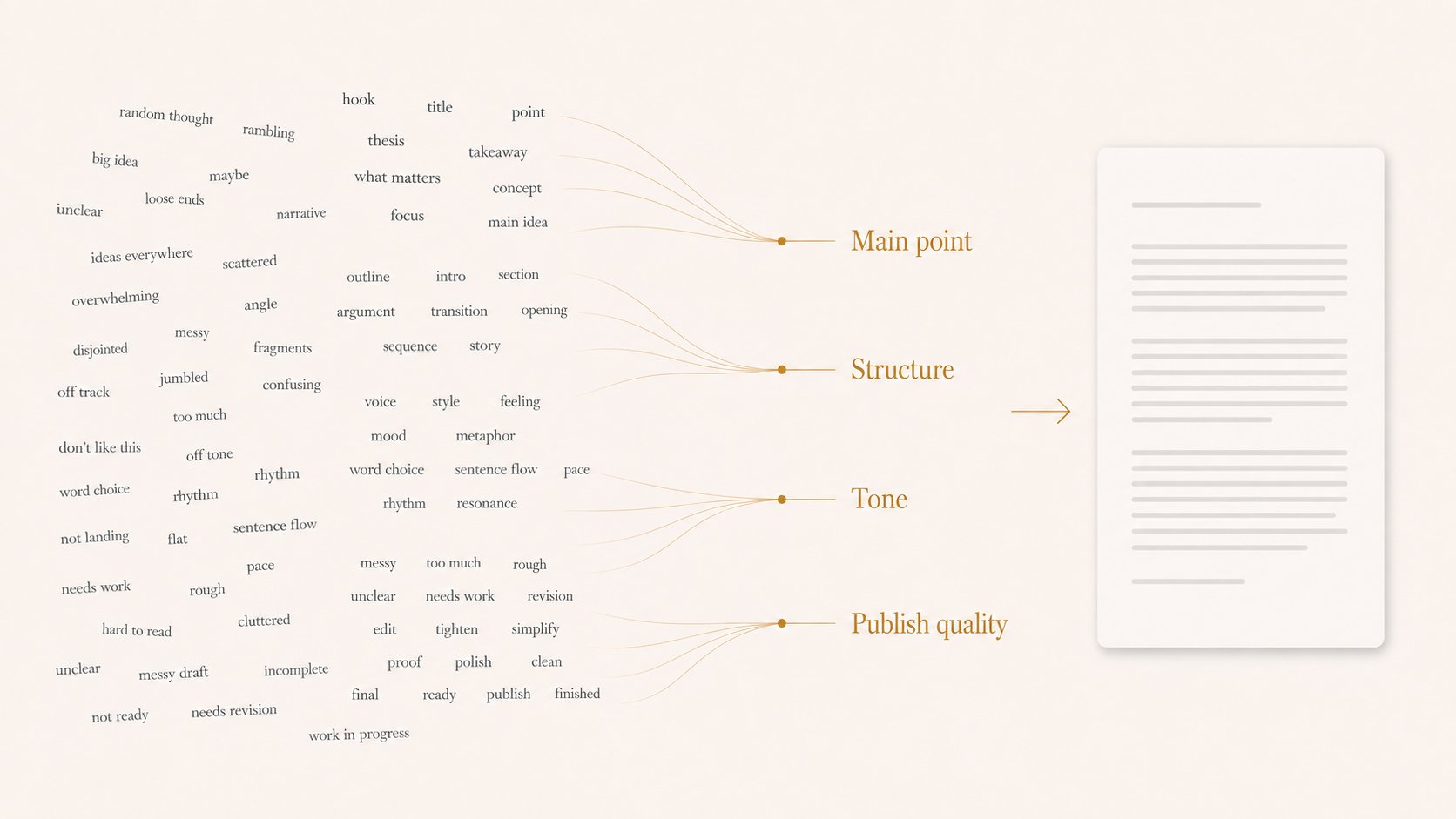
And you can do this to! Whether you are an experienced writer, or a novice.
Add whatever else gives you a useful map to navigate the piece quicker: Who is your audience, and what do they already know? Why is this piece important to you? What kind of examples do you want to use?
Or just ask ChatGPT to ask you fundamental questions until you gain clarity. 🙂
So next time the words just don’t flow, create a roadmap for them. Writing fast can just mean deciding fast.